Luxembourg's B2B E-Invoicing Mandate to Apply from 2028
Luxembourg has approved a draft law extending the mandatory e-invoicing obligation beyond public procurement (B2G), with entry into force expected from 2028.


Latest updates on Luxembourg's B2B e-invoicing mandate
Taking another step forward, the government formally submitted Bill 8815 to the Chamber of Deputies, setting out the detailed rules for the future mandate.
The bill confirms that a compliant e-invoice must be issued, transmitted, and received in a structured format that meets the European standard and an authorised syntax. PDFs, Word documents, scans, and images will not qualify as invoices, though they may still be attached as supporting documents.
Other key points of Bill 8815:
- No consent required: recipients will no longer be able to reject a compliant invoice solely because it is electronic.
- No extra charges: suppliers are prohibited from charging additional fees for issuing a compliant e-invoice.
- Self-billing permitted, provided it is agreed in advance and accepted invoice by invoice.
- Common, interoperable, and secure delivery network, with the ability to receive and process related status or response messages.
- Scope: invoices required under Luxembourg VAT law between suppliers and recipients established in Luxembourg, with narrow exclusions for occasional sales of new means of transport, the "VAT logement" regime, and B2C intra-EU distance sales deemed made in Luxembourg.
Thresholds and deadlines: the issuance obligation from 1 July 2028 will apply to businesses exceeding two of the following three criteria (based on 2026 year-end figures): a balance-sheet total of €7.5 million, net turnover of €15 million, or 50 employees. Businesses relying on transitional alternative solutions beyond the regulatory caps will face a progressive usage fee: €2 for each of the first 20 invoices over the cap, €3 for the next 30, €4 for the next 50, and €5 beyond 100.
The law is set to enter into force on 1 January 2028.
Luxembourg's B2B e-Invoicing mandate: what you need to know and key dates
On 17 July 2026, the Luxembourg government approved a draft law that will make e-invoicing mandatory for domestic B2B transactions, with a phased rollout between 2028 and 2029. Until now, e-invoicing has only been mandatory for transactions with the public administration, while B2B e-invoicing has remained optional, subject to the buyer's agreement.
The rollout is expected to follow this phased timeline:
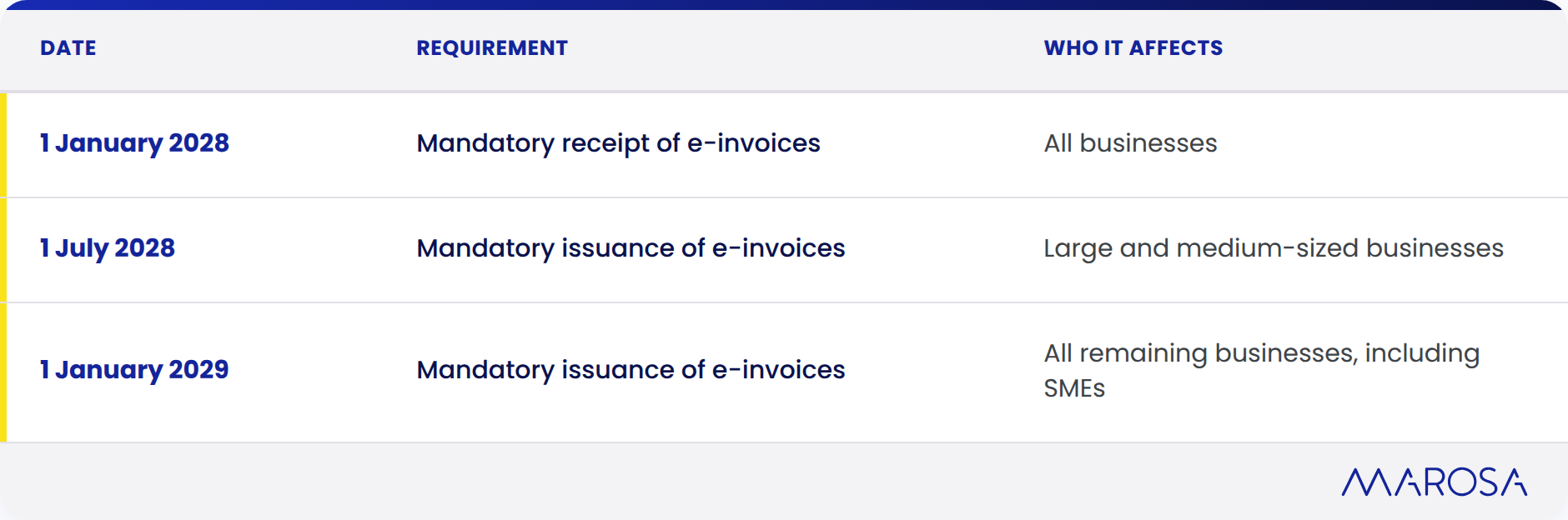
These dates and the scope of the mandate stem from a draft law and draft regulation approved at Council of Government level. As the text has not yet been enacted, both the dates and the scope may still change before the mandate takes effect.
Which network will Luxembourg use?
Alongside the draft law, the government also endorsed a draft Grand-Ducal Regulation setting up a common delivery network for e-invoices, so that businesses aren't forced to adopt separate, incompatible systems. This points to continuity with Luxembourg's existing B2G infrastructure: the Peppol network, using the EN 16931 standard (Peppol BIS 3.0).
If your business already exchanges e-invoices with Luxembourg's public sector via Peppol, that same connectivity is likely to extend to your B2B transactions.
Is Luxembourg introducing real-time VAT reporting too?
Not for now. This reform covers e-invoicing only, and Luxembourg has not announced a real-time reporting obligation alongside it. The one digital reporting obligation on the horizon for Luxembourg businesses is the EU cross-border digital reporting requirement (DRR) under ViDA, which applies from 1 July 2030 and is being transposed through a separate bill covering Article 2 of Directive (EU) 2025/516.
We will call you back
Give us your contact details and our team will contact you to organize a demo and evaluate how you can integrate your system with our tool.